RedLab Request early access
Talk to us about your stack

Same stack.
Synthetic data.
Real attacks.

RedLab rebuilds your stack in a private lab, version-pinned to production, and attacks the copy. Only findings that survive adversarial review reach you, in plain English.

Your live systems are never touched.

How it works

Your stack, copied. Then attacked.

  1. 01 · Copy

    Version-pinned to production

    We rebuild your stack from your code and its versions, and fill it with synthetic data.

  2. 02 · Attack

    Attacked like the real thing

    Agents attack the lab, the way a real attacker would. Never production, never real data.

  3. 03 · Challenge

    Only what survives reaches you

    An adversarial review tries to knock each finding down before you ever see it.

Method

Built like an audit, not a chatbot.

Purpose-built AI agents do the work, inside a harness that checks everything they claim.

Evidence or nothing

A finding is rejected unless every line of code it quotes is found, word for word, where it says.

Verdicts decided by code

The adversarial review answers fixed questions. Rules, not persuasion, decide the outcome, so it can't be talked round. Anything unclear is marked "needs validation".

Graded proof

Every finding states how far it was proven: a pattern, a traced path, a test that runs in a sandbox, or impact shown in the lab.

Fenced agents

Read-only code, no network while hunting, and every action logged against the run, so you can see exactly what was done.

Recognised standards

Checks map to CWE and the OWASP Top 10 for LLM applications, alongside Cloudflare's open-source security-audit checklists and our own Laravel and AI-feature checks.

Benchmarked

Scored against a deliberately vulnerable Laravel app with a known answer key, planted bugs and decoys, matched one to one.

How the harness works, in detail →
Sample findings

What lands on your desk.

Every finding is challenged and explained in plain English, with a suggested fix where one fits, ready for your developers to review. Anything that can't survive the challenge is dropped.

CriticalCVSS 9.1 · CWE-639 · OWASP LLM01, LLM06

Cross-tenant data leak through the AI assistant

  1. Hidden text in an uploaded PDF tells the assistant to search all records.
  2. The search_records tool takes its tenant ID from the model's arguments, not the session.
  3. The assistant returns another customer's records in its answer.
Lab
Ubuntu 26.04 · PHP 8.6 · Laravel 13 · MySQL 9.7 · model stub
Attack
Reproduced 3 of 3 runs, two synthetic tenants
Challenge
Stands · no server-side tenant check on the tool
Fix
Bind the tenant to the session on the server; never accept it from the model
HighCWE-22 · nginx 1.30

Secrets file served through an nginx alias

Lab
Ubuntu 24.04 · nginx 1.30 · PHP 8.5-FPM, as on the live server
Attack
Reproduced · GET /assets../.env returns the app's environment file (synthetic secrets)
Challenge
Stands · location /assets lacks its trailing slash
Fix
Add the trailing slash to the location and alias; rotate the exposed keys
HighCWE-918

Webhook test reaches internal services

Lab
Ubuntu 26.04 · PHP 8.6 · Redis 8.12 · Horizon dashboard on localhost
Attack
Reproduced · "Send test" fetches http://127.0.0.1/horizon/api/stats and shows the reply
Challenge
Stands · no check on private or loopback addresses
Fix
Resolve the host first and refuse private ranges; don't echo the reply
DisprovedNot reported

SQL injection in the sort parameter?

Hunt
The sort value is placed into orderByRaw()
Challenge
Knocked down · the value is checked against an allow-list of five column names first; 40 payloads all fall back to the default sort
Result
Dropped. You never see it, and nobody wastes a morning on it
A real report

This is what you get.

Straight from a demo run on a deliberately vulnerable test app: the business impact first, then the code, the steps to reproduce and the fix.

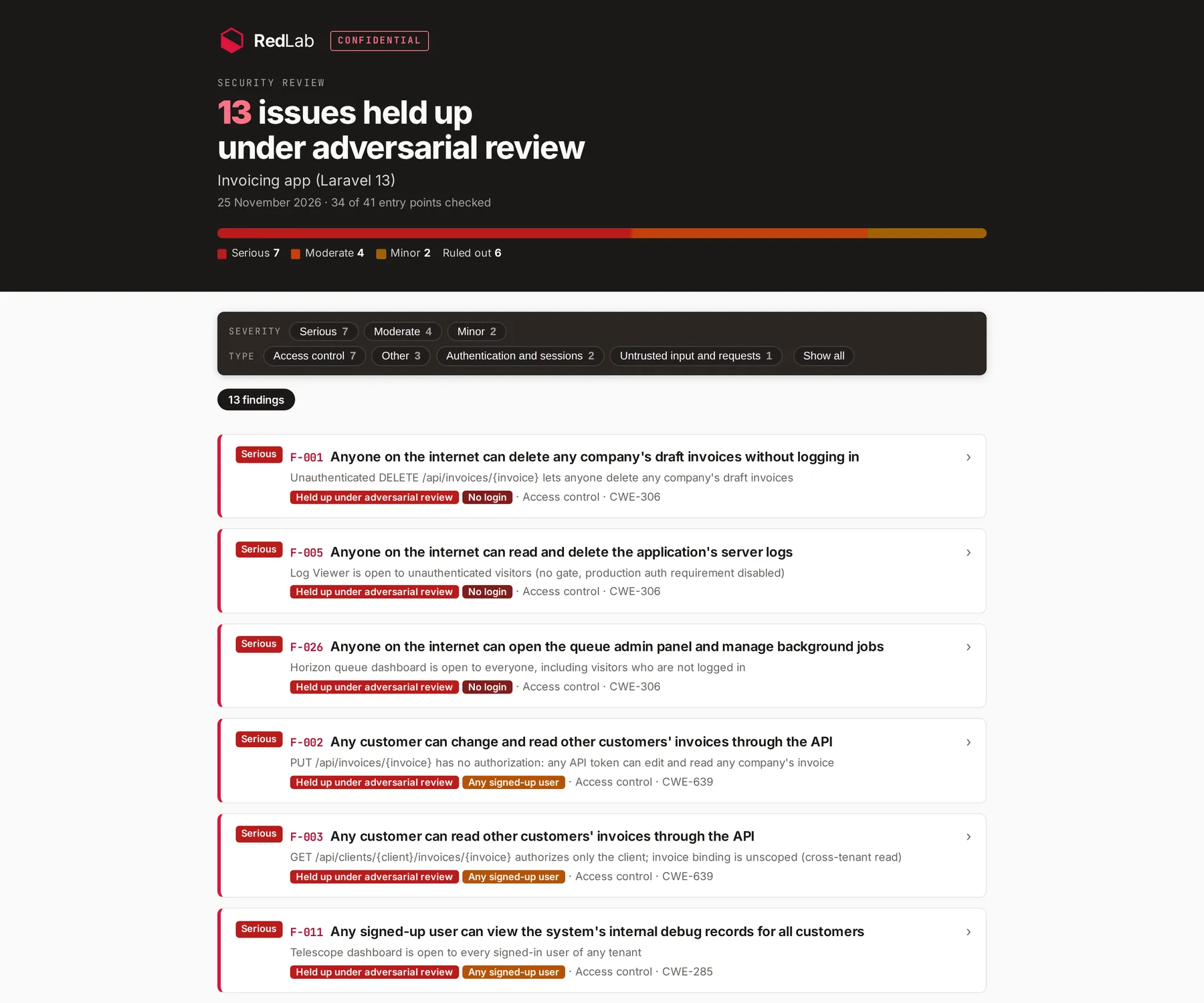
The first page of a RedLab report: 13 issues held up under adversarial review, a severity breakdown, filters, and the findings in plain English.
The report: what held up, at a glance
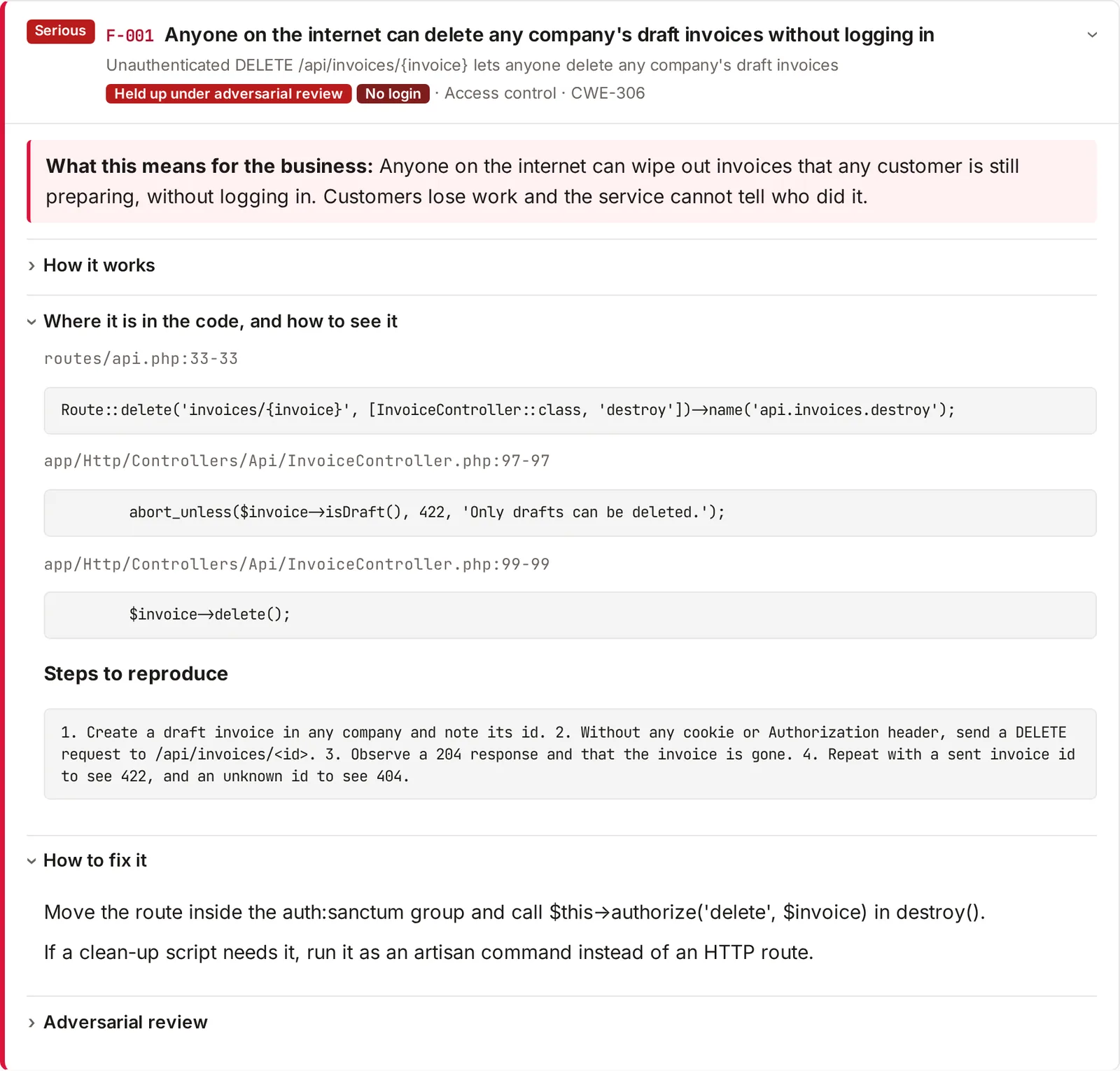
A finding in a RedLab report: what it means for the business, where it is in the code, steps to reproduce, and how to fix it.
One finding, opened up
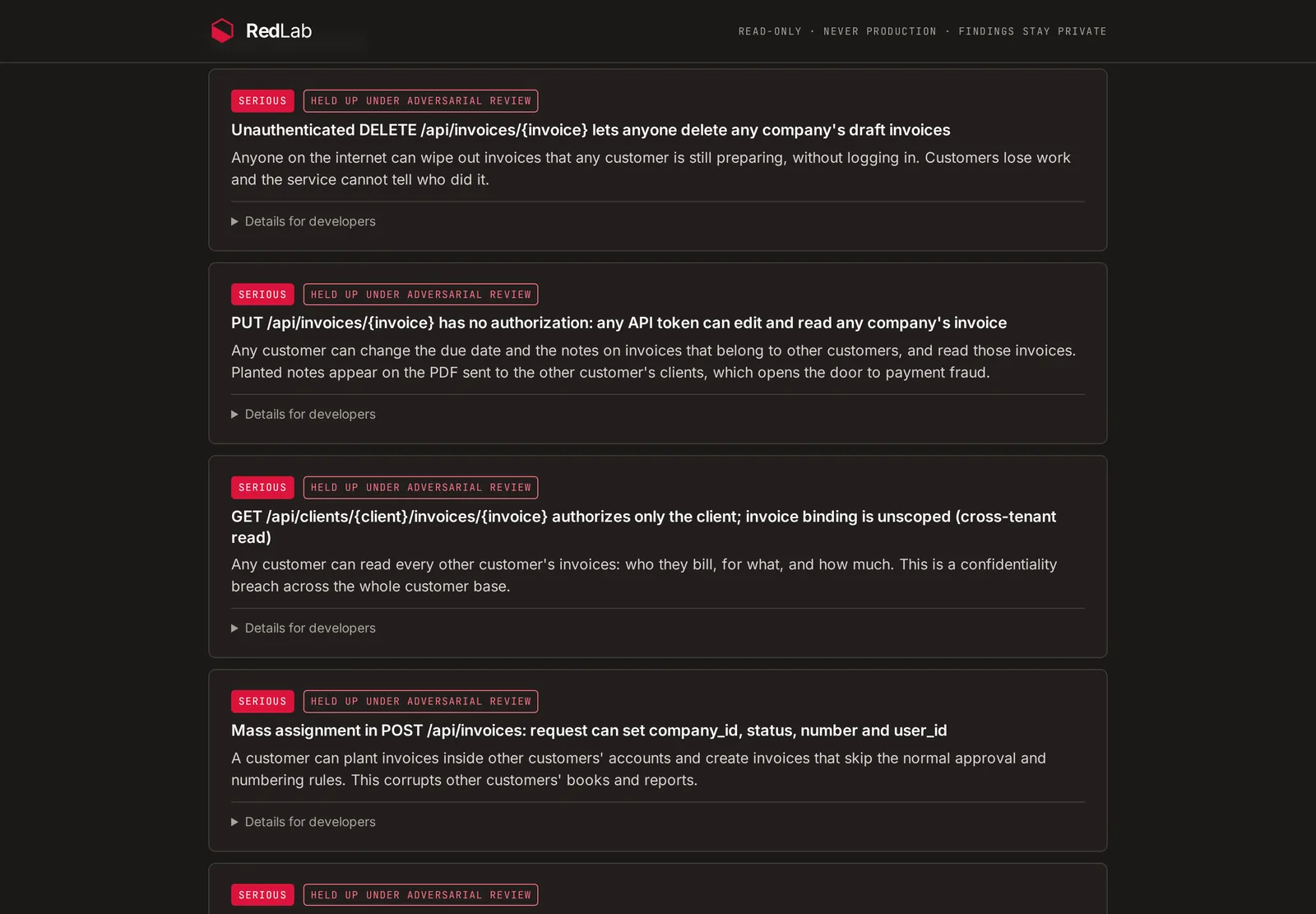
The RedLab app showing a finished check: findings that held up under adversarial review, each explained in plain English.
The finished check in the RedLab app
Coming next

Beyond testing.

The same evidence-first approach, applied to the rest of your security operations.

Coming

Security monitoring and response

Logs from your servers, databases and Cloudflare collected in one place, analysed against tuned rules, and turned into alerts that matter. Vulnerabilities tracked, a planned response for every alert, and a monthly report of what happened.

Coming

Cloudflare baseline and drift watch

One hardened set of Cloudflare security rules across all your sites, checked continuously, with any drift flagged and put right in one step.

Coming

Configuration audit

Server, Cloudflare and application settings reviewed against current best practice, with plain-English recommendations ranked by risk.

Coming

Resilience and backups

Redundancy and backup strategy reviewed, restores rehearsed and timed, and a recovery plan your team can actually follow.

Coming

Accessibility and speed

WCAG 2.2 AA accessibility and performance audits run against the lab, reported beside your security findings.

Need something else?

Tell us what keeps you up at night. If it fits how we work, it goes on this list.

Request early access →
House rules

Lines we don't cross.

Who's behind it

Born from running production security.

RedLab's founder has 25 years in IT, infrastructure and software engineering, 17 of them building and running a digital agency and a SaaS platform. Today that means running security operations for a live AI platform in production: SIEM monitoring, WAF policy, disaster-recovery rehearsals and pen-test readiness.

Early access

Be one of the first runs.

Tell us what you run and what worries you. We'll tell you what a first run would look like.

  1. 01We read your note, personally.
  2. 02We reply, usually within two working days.
  3. 03If it's a fit, we scope a first run together.

We use these details only to reply to you. Privacy notice